Yash Patel's Soul Jam doesn't ask you to listen. It invites you to belong.
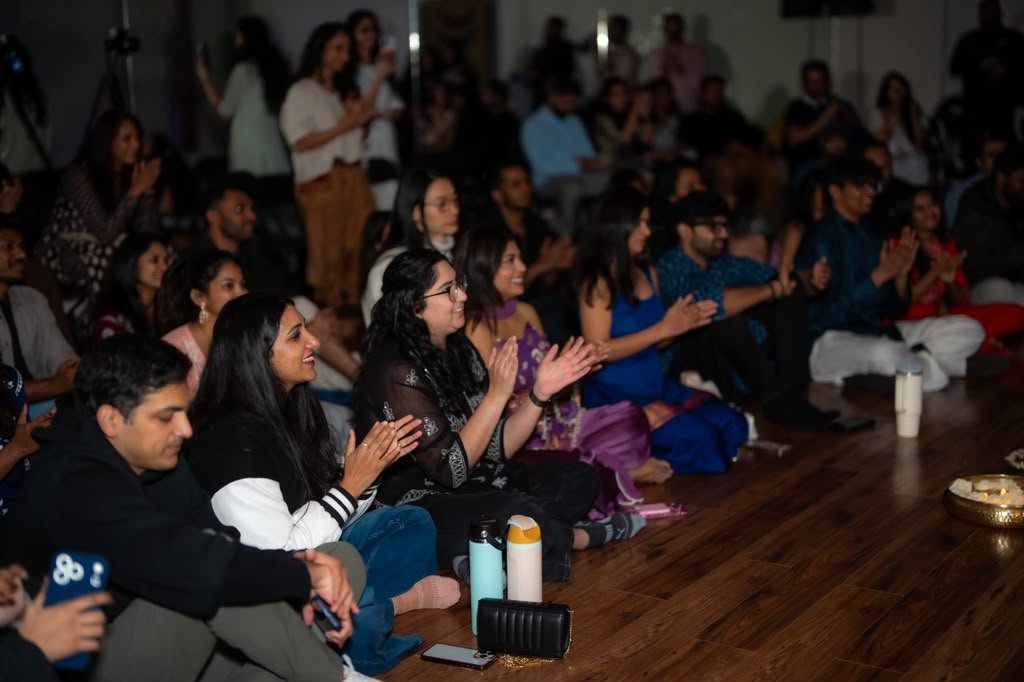
Some shows you watch. Soul Jam, you feel — in your ears, yes, but also in your hands, in your taste, in your memory.
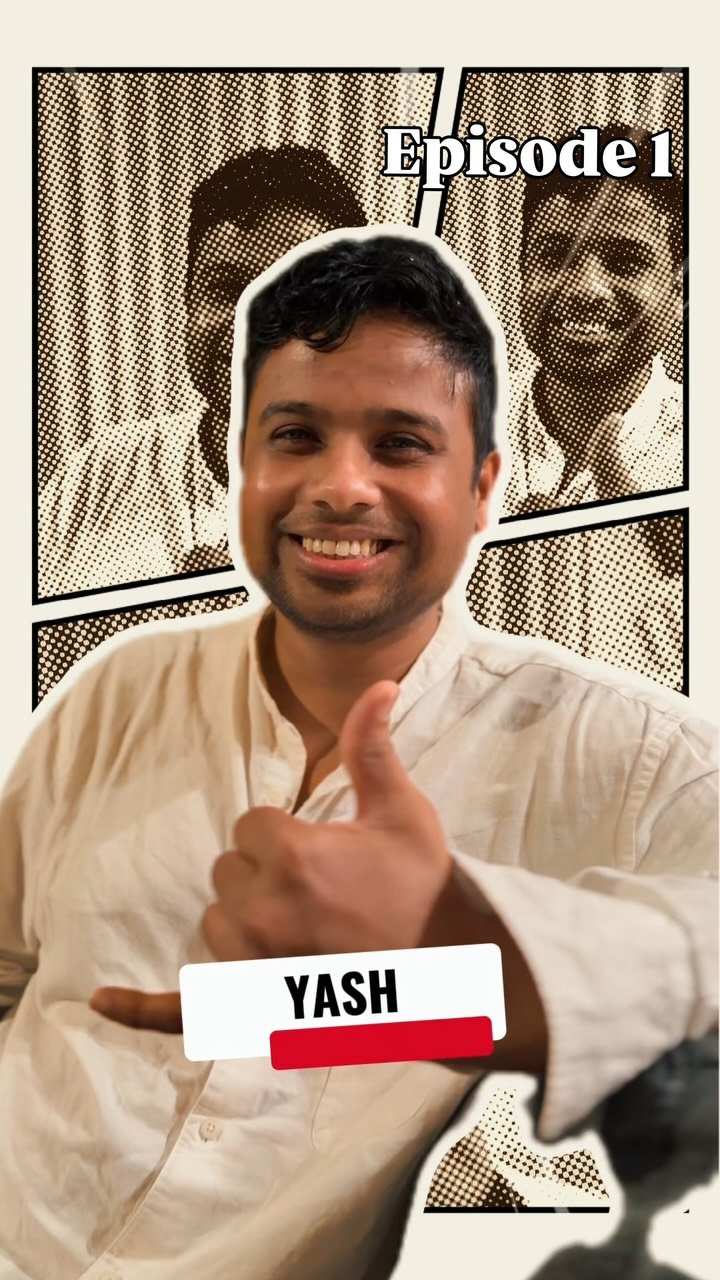
By day, Yash Patel is a security engineer at Microsoft with a PhD in cybersecurity. By night, he's building something Seattle didn't know it was missing: an immersive evening of South Asian music and poetry, where songs aren't performed so much as told — story first, music woven through, the audience pulled all the way in. Part concert, part theater, part living-room gathering. Three shows deep, every one a full house.
Ask him what he's really doing up there, and he won't say "singing." He'll say "connecting."

"Jai Shri Krishna": a family that noticed
Passion you have, never dies. You always find your folks.— Yash Patel
Yash grew up in a Gujarati business family in western India, the first kid in the family to graduate, let alone earn a PhD. But before engineering, there were bhajans — the devotional songs Hindu families sing together, everyone's voice welcome. At one of those evenings a young Yash started singing, and his parents noticed. They got him coached. After high school came music college at Maharaja Sayajirao University: theory, vocals, the works.
Then came the choice so many artists know. Yash stepped away from music and chose engineering. The art went quiet, but it never left. Through engineering college he kept finding his people, performing at cultural festivals across Ahmedabad and at Mood Indigo, one of Asia's largest college arts festivals — sometimes at the cost of attendance sheets.
Years later, the kid who sang at family gatherings is still at it — now with Hindustani classical music in his heart, legendary ghazal singers Jagjit Singh, Ghulam Ali, and Mehdi Hassan on his playlist, and a soft spot for vinyl. (Yes, he's found the vinyl room at Microsoft.)
Where's Seattle's Imtiaz Ali?
Seattle, Yash will tell you, is one of the richest cities anywhere for music and art. What he couldn't find was the storyteller. In Indian cinema that role belongs to filmmakers like Imtiaz Ali — the Bollywood director whose films treat music not as soundtrack but as the story itself, every song an emotional journey. Yash kept asking: who's doing that for a live stage in Seattle? Who takes a song you've heard a hundred times and makes you feel the story behind it for the first time?
In a world of endless internet scrolling, where everyone is moving fast and staying busy all day, Yash had a broader challenge in mind: how can an artist make people pause for two hours when technology is constantly encouraging them to keep scrolling?
How can you slow everyone down? How do you make them part of the show? Why can't I include them?— Yash Patel
His answer: don't dumb it down — go deeper. Raw, untold stories with a musical touch. Poetry, including the ghazal, South Asia's centuries-old form of sung poetry about love and longing, and the works of lyricists like Javed Akhtar, Gulzar, and Sahir Ludhianvi, delivered in a way a new generation can walk into, whether or not they grew up with it. That experiment started with a group of friends. When they hung out, they simply jammed, talked, listened, paused, and felt the music around them. As Yash found more people around him, connected with Seattle's diverse musical community, and performed opening acts for many artists, those intimate musical gatherings became Soul Jam: every set built around a real story, every story carrying its songs. One night, the audience isn't just hearing the songs of Kishore Kumar, one of India's most beloved playback singers; they're sitting inside the story of Madhubala, the icon often called India's Marilyn Monroe, hearing the songs written for her, feeling what she felt.
All five senses, one room
Here's where Soul Jam stops being a concert and becomes something else entirely. Yash's rule: if he sees one person's attention drift, that's on him. So he designed the show to hold you through every sense.
How about we get all the senses? Touch all five senses; let the audience pause there for two hours.— Yash Patel
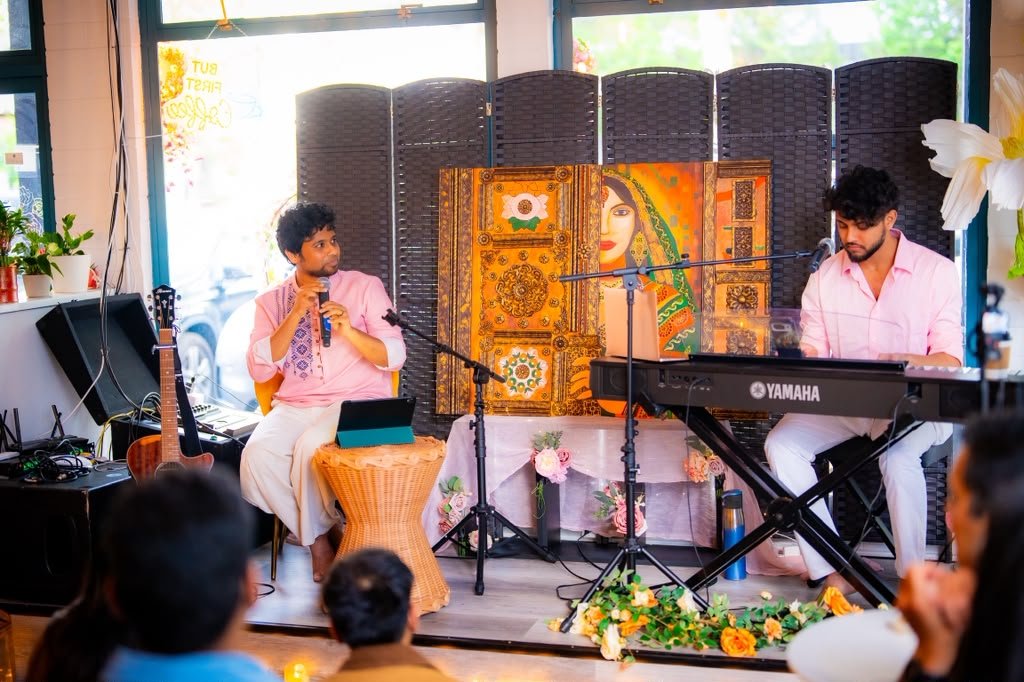
His Mother's Day show at Ada Social is the proof of concept:
Guests walked into a room fully transformed, with décor built around the phases of a mother's life and her paintings glowing on the big screen. Before a note was played, it was already touching you.
The stories themselves include that of Bulleh Shah, the revered 17th-century Punjabi Sufi saint and poet whose verses — once sung by women at the spinning wheel — have been carried forward for centuries. Yash performed a Punjabi song from that legacy, the product of deep research into how a local artist can bring a centuries-old story to life.
A trip back in time: the after-school snacks your mother had waiting when you walked in — instant noodles, puffs, and biscuits. Different pantry, same feeling, no matter which continent you grew up on. The whole room transported to childhood at once.
This one gets people. Guests were handed soft pieces of cloth, with every color representing a different quality they had inherited from their mother. The gentle fall of the fabric felt like a mother's saree — the kind of softness you knew before you had words for it. Hold it, and suddenly you're small again, standing next to her.
And through it all, one open invitation: be yourself, sing with me, no restrictions. Whether the story is about a Sufi saint, a Bollywood legend, or all of us, the audience isn't watching the show. They are the show — and you don't need a word of Hindi or Punjabi to be part of it.
The experience, it becomes one harmony.— Yash Patel
Design docs, chai pe charcha, and a vintage piano
The music, Yash says, is the easy part. He loves those three-hour rehearsals. The hard part is everything around it: finding the right venue, or transforming one — like The Royal Room with its vintage piano; researching untold real-life stories until each one is ready to be told; and convincing a venue to say yes to the full vision.
It's a team sport, and he knows it. Artists, hosts, décor, and audience all play a part. Most importantly, his wife Arunima is the creative brain behind every show. She does more than peer-review the Soul Jam design doc; she helps create content, shape the branding and marketing, work with the host on décor, and execute the small creative elements that make the audience pause, think, and feel the energy. And yes — this Microsoft engineer runs design doc reviews at home, while the next set takes shape over long conversations with friends and endless cups of chai.
I don't believe it's a product or an idea I'm putting out there. The audience is part of the show.— Yash Patel
The Shadows Behind the Spotlight
The next Soul Jam turns to Madhubala, the screen icon they called the Venus of India. But icons are rarely born; they are written. Before the flashbulbs and the legendary smile, there was a quiet girl named Mumtaz. This edition pulls back the heavy curtains of stardom to ask: was the fame her dream, or a script handed down by someone else? 🌹
A musical chronicle told through soulful storytelling and poetry, woven into a live acoustic landscape of timeless melodies — creating an intimate space for retro souls and classic cinema lovers to pause, think, and feel together. All contributions support the Live2Serve Foundation's Cultural Preservation and Promotion work through Kalakaar. 🎶

The cause is the fuel
Soul Jam: Madhubala is a nonprofit effort. 100% of contributions go to the Live2Serve Foundation in support of its Cultural Preservation and Promotion vision through Kalakaar, part of its Indian representation initiative. Yash is often asked to bring Soul Jam to private events. He is open to the possibility, but the project has not yet found the right fit. The cause is the fuel — and any future partnership has to align with Soul Jam's artistic purpose and community values.
The roots run deep here, too. As a kid, Yash sat beside his dad and uncle at concerts by legends like Jagjit Singh — the man who brought the ghazal to millions — and playback singer Mohammed Aziz. Today his ears range wide: jazz-inflected ghazals, contemporary voices like Papon, and the poetry of Javed Akhtar, Gulzar, and Sahir Ludhianvi, always circling the same conviction: not all poetry is ghazal, but every ghazal is poetry.
See Soul Jam
One night, one story, all five senses, and a full house of people singing along — guaranteed. No background required; just come curious.